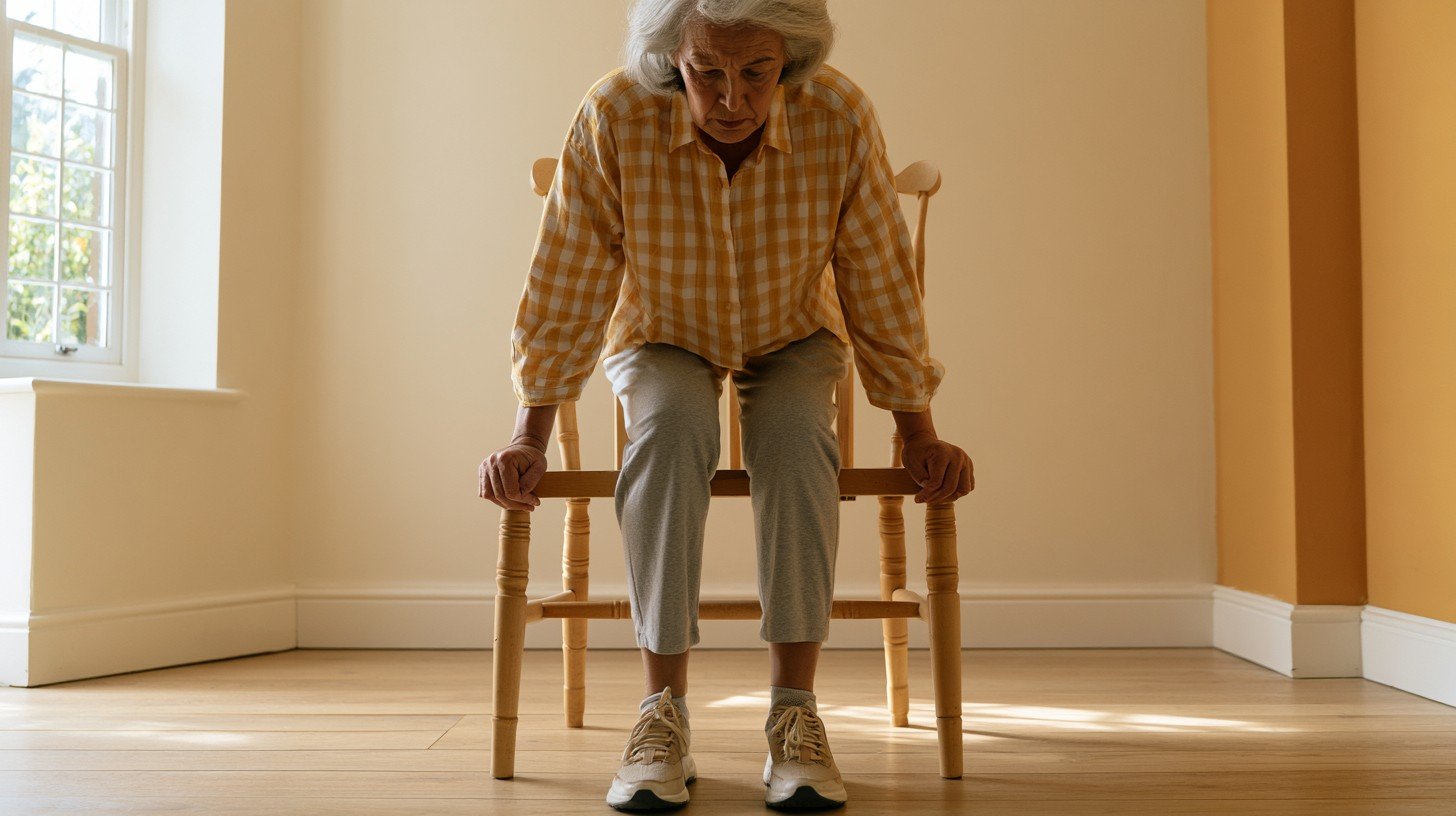
James had been grabbing the armrest, leaning back, and holding his breath every time he stood up. It worked most of the time. But the walk that followed was always harder than it should have been. He assumed the chair rise was unavoidable. What he did not know was that his technique was working against the joint rather than with it.
A systematic review and meta-analysis of 14 studies found that adults with knee OA show significantly higher peak external knee flexion torque during sit-to-stand than age-matched healthy controls. The review also confirmed that increased trunk flexion is the documented compensatory strategy the body uses to reduce that demand (Sonoo et al., 2019). James’s backward lean was the opposite of what the research supports.
Key Takeaway
A systematic review of 14 studies found that adults with knee OA show significantly higher peak knee flexion torque during sit-to-stand than healthy controls and adopt increased trunk flexion as a compensatory strategy (Sonoo et al., 2019). In community-dwelling older adults, five-time sit-to-stand performance correlates significantly with gait speed (de Abreu et al., 2022).
This post covers why how to get up from a chair with knee pain is harder in knee OA, what the usual technique gets wrong, 5 steps grounded in research, and how chair rise connects to walking.
Ready to Find Out What Your Body Can Do?
It takes less than 3 minutes. No gym. No equipment. Just a simple test that shows you if your body can do more than it’s been telling you.
M3 is a behavioral wellness coaching program. It is not medical treatment and does not replace advice from your physician. Consult your doctor before beginning any new movement or nutrition program.
Table of Contents
Why is getting up from a chair hard with knee pain?
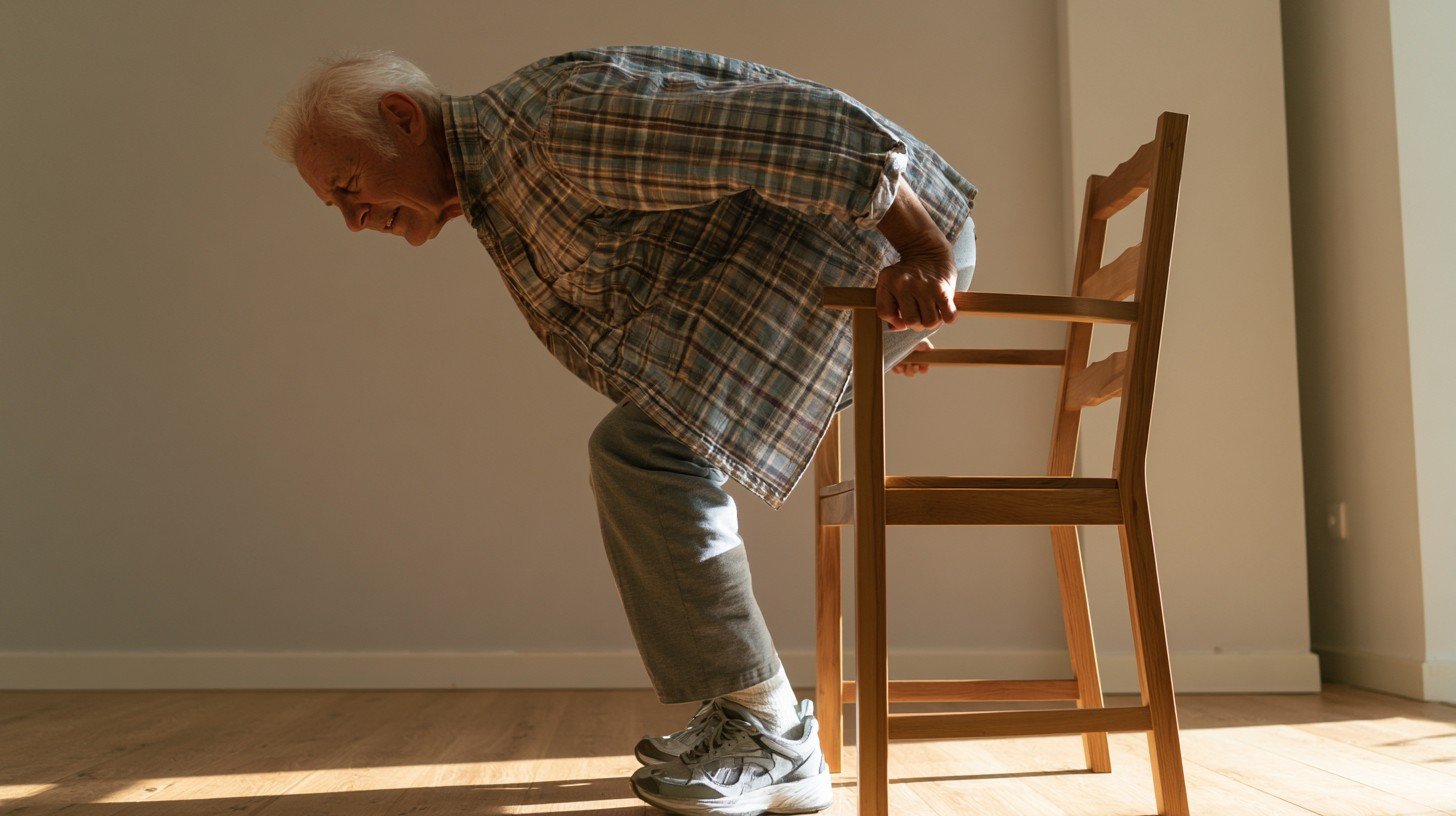
Because the knee works harder during those first two seconds of standing than during most of the walk that follows.
A systematic review and meta-analysis of 14 studies compared sit-to-stand biomechanics in adults with knee OA against age-matched healthy controls. The knee OA group showed significantly higher peak external knee flexion torque during the rise. Sit-to-stand is identified as a more sensitive movement for detecting biomechanical differences in knee OA than gait, because the knee reaches a greater range of flexion and higher torque during chair rising than during level walking (Sonoo et al., 2019).
For adults who notice that how to get up from a chair with knee pain feels harder than the walk itself, that observation is biomechanically accurate. The chair rise asks more of the knee per second than walking does, and asks it all at once before the joint has had time to warm up.
That same structural sensitivity explains why morning knee stiffness is most pronounced in the first movements after rest. The chair rise is the morning’s hardest task compressed into two seconds.
What goes wrong with the usual way of standing up?
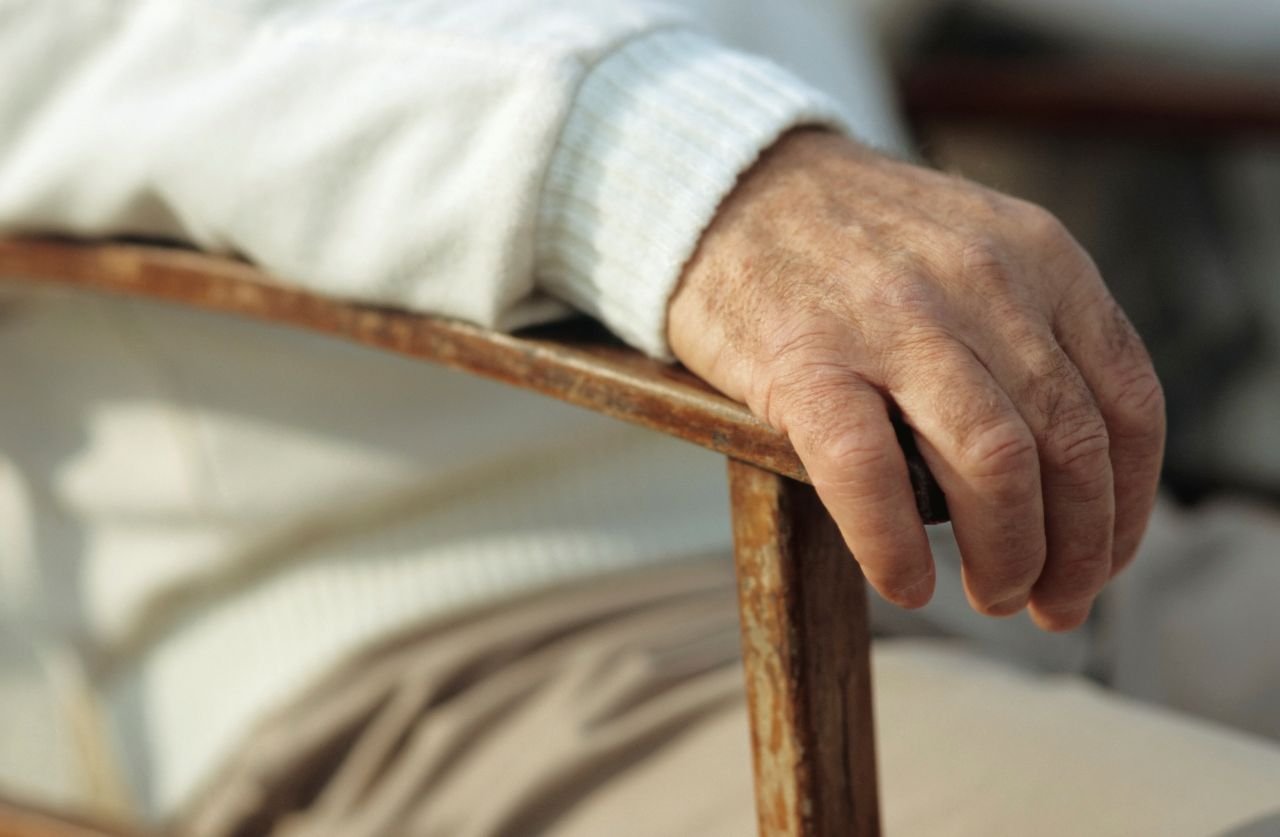
The weight stays in the wrong place for too long.
Most adults rise by pressing back into the chair, pushing straight up from there, and relying on the quadriceps to lift their full body weight. The quadriceps are the primary knee extensor group. In a joint managing knee OA, asking them to carry the majority of a high-torque movement produces the familiar sharp sensation at lift-off.
Research on sit-to-stand in knee OA confirms what the body already tries to do. Adults with knee OA adopt increased trunk flexion as a compensatory strategy, shifting the center of mass forward over the feet to reduce demand on the knee extensors. The backward lean overrides that strategy before it can work.
Understanding how to get up from a chair with knee pain starts with recognizing that moment. The weight-over-feet principle that makes walking with bad knees more manageable applies in the two seconds before the first step is taken.
How to get up from a chair with knee pain: 5 steps
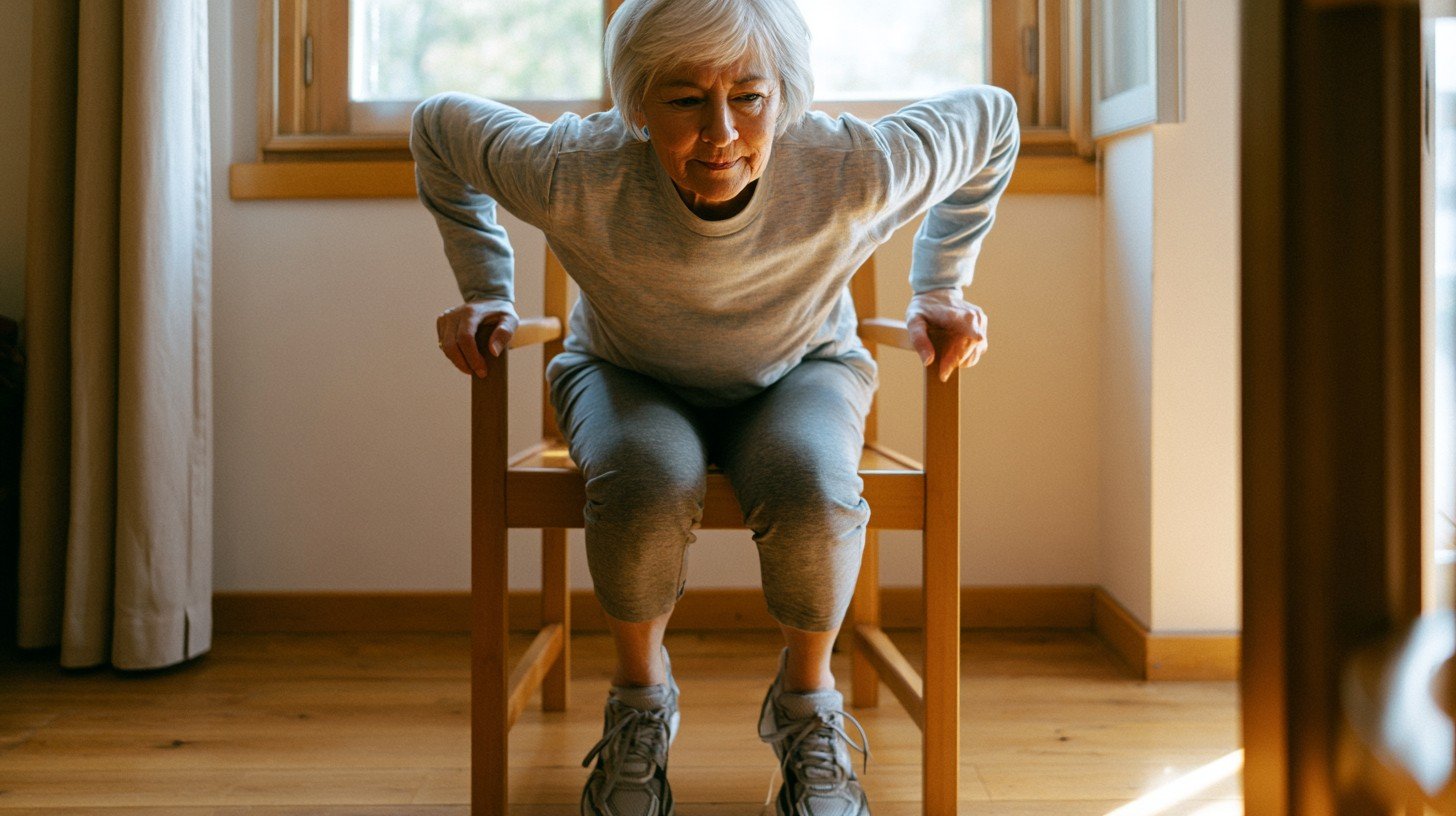
Five steps. The sequence matters because each one sets up the next. This is how to get up from a chair with knee pain using the weight-over-feet approach, which the research supports.
Step 1. Scoot to the front edge of the seat
Move forward until you are sitting on the front third of the seat. Most adults sit too deeply in the chair to rise efficiently. Getting your hips closer to the edge shortens the mechanical distance your weight needs to travel to get over your feet, which makes every step that follows easier.
Step 2. Position your feet
Place feet hip-width apart, slightly tucked back under the chair. A toe-in angle of roughly 10 degrees significantly reduces the knee adduction moment during sit-to-stand in adults with knee OA (Faroughi et al., 2023). Feet extended forward of the knees is the most common setup error.
Lean forward, nose over your toes
Tilt your upper body forward until your nose is approximately over your toes before rising. This trunk flexion shifts your center of mass over your feet, reduces quadriceps demand, and converts the rise from a knee-dominant effort into a whole-body movement.
Step 4. Push through your heels and let your hips lead
Press through your heels as you rise. Think about driving your hips forward rather than straightening your knees. This activates the glutes and reduces how much the quadriceps and the knee joint need to contribute.
Step 5. Pause at the top before your first step
Once standing, take a full breath before walking. This pause lets the knee joints settle under load, prevents the rushed first step that often produces the sharpest post-rise pain, and gives the nervous system a moment to register stable standing.
Why chair height makes a bigger difference than most adults realize
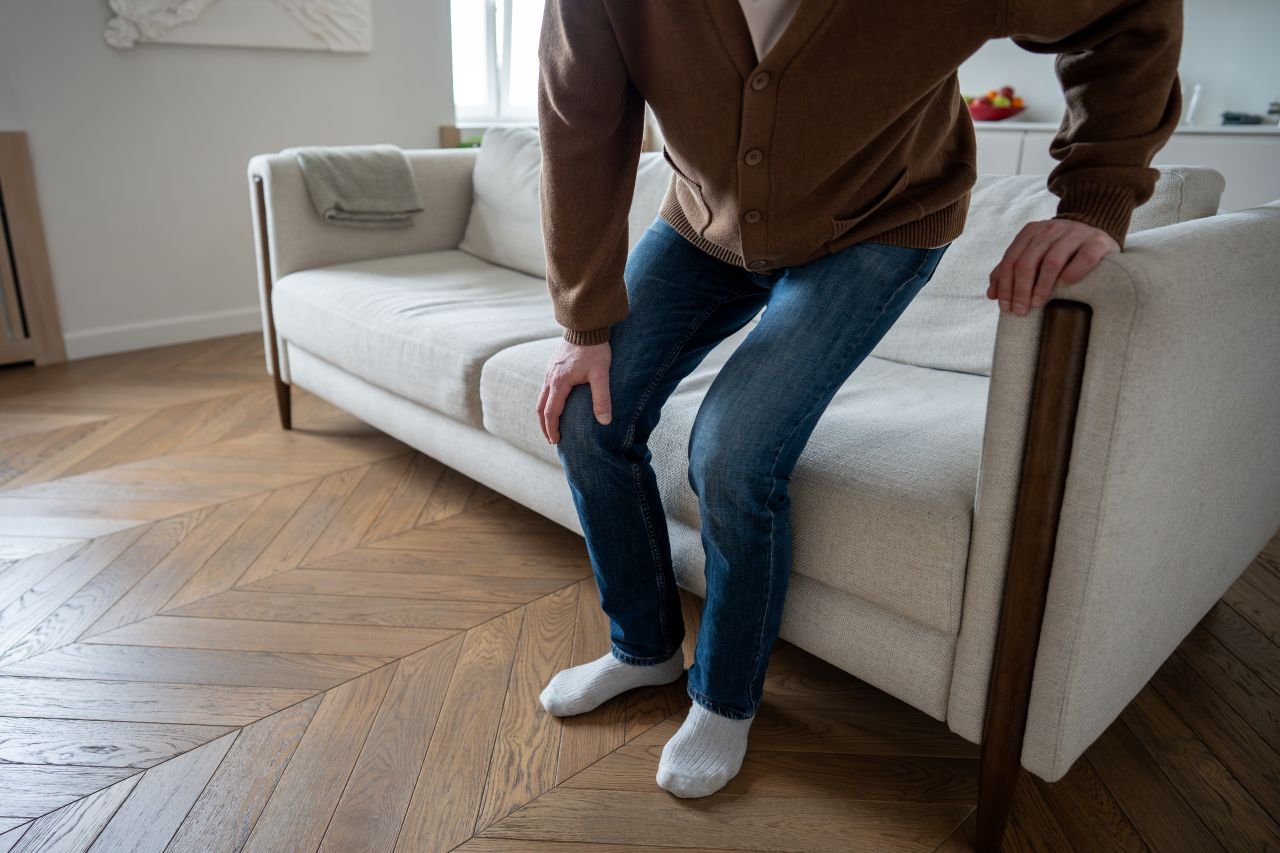
The technique matters most when the chair is not working against you. Chair height is the variable most adults never adjust.
Research consistently confirms that lower seat heights require greater peak hip and knee joint moments during sit-to-stand. The lower the seat, the further the hips must travel before the weight gets over the feet, and the more the knee extensors have to contribute. The difference between a standard dining chair at 17 to 18 inches and a deep sofa at 12 to 14 inches is not minor. The knee does measurably more work from the sofa.
A firm cushion that raises a low seat two to three inches is one of the simplest modifications available. Chairs with armrests allow the upper body to share the load on high-pain days. Choosing the taller chair at the dinner table is applied biomechanics, not a concession.
This is also part of why knee pain is often worse at night. Evening hours typically mean the lowest furniture in the house. How to get up from a chair with knee pain is harder from the couch than anywhere else in most homes.
How getting up from a chair connects to daily walking
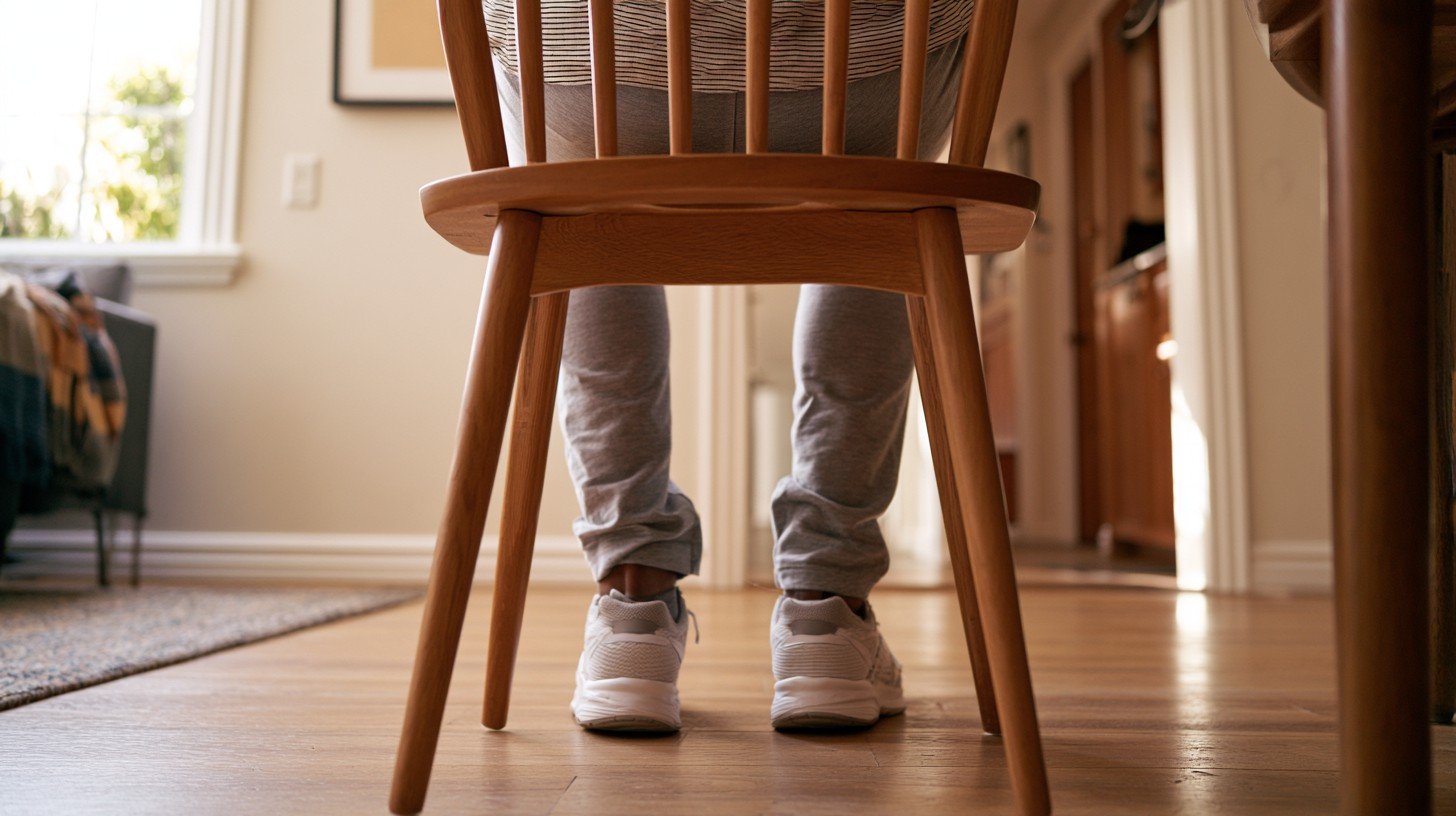
More directly than most adults expect.
In community-dwelling older adults, five-time sit-to-stand performance correlates significantly with gait speed, and poorer chair rise performance consistently predicts reduced walking speed. The World Health Organization recognizes sit-to-stand ability as a measure of locomotor capacity, placing it in the same category as walking (de Abreu et al., 2022).
Every walk begins with a chair rise. The joint that absorbs the highest torque demand of the day in the first two seconds of standing then carries that load into the first steps of the walk. James’s pattern of a hard rise followed by a hard walk was not coincidental. The chair was the first obstacle in every walking session.
Improving how to get up from a chair with knee pain changes the starting point. A joint that completes the rise with less demand arrives at the first step with more reserve.
The goal is walking 30 minutes. Getting up from a chair is where that goal gets easier or harder, several times a day, before a single step is taken.
Wrap-up: How to get up from a chair with knee pain
James stopped leaning back. He stopped holding his breath. The walks that followed got easier. Not because his knee changed, but because the first two seconds of each walk did.
Three findings worth keeping: sit-to-stand places higher biomechanical demand on the knee than walking, foot position and trunk lean measurably reduce that demand, and chair rise ability and gait speed move together in older adults.
The goal is walking 30 minutes. How to get up from a chair with knee pain is where that goal starts each time, before the first step is taken.
How to get up from a chair with knee pain is one piece of a larger picture. The complete guide to knee pain relief for adults over 55 covers the full approach.
Ready to Find Out What Your Body Can Do?
It takes less than 3 minutes. No gym. No equipment. Just a simple test that shows you if your body can do more than it’s been telling you.
M3 is a behavioral wellness coaching program. It is not medical treatment and does not replace advice from your physician. Consult your doctor before beginning any new movement or nutrition program.
Frequently Asked Questions
What type of chair is easiest to stand from with knee pain?
A firm, straight-backed chair at 17 to 18 inches seat height with armrests that reach the front edge of the seat is the most biomechanically favorable option. Firmness prevents hips from sinking below knees, height reduces the torque required to rise, and front armrests allow the upper body to assist on difficult days. Knowing how to get up from a chair with knee pain starts with selecting the right chair.
Should you use armrests when getting up from a chair with knee pain?
Yes, on high-pain days, armrests are a biomechanically sound option. Using the arms reduces the load transferred to the quadriceps and knee joint during the rise. The five-step technique still applies with armrests. Scooting forward, positioning feet, and the nose-over-toes lean all reduce knee demand on top of what the armrests provide. How to get up from a chair with knee pain using armrests is a smart adaptation, not a shortcut.
How many times a day should you practice the five-step technique?
Every time you stand up. The technique becomes efficient through repetition in real situations, not dedicated practice sessions. Most adults over 55 rise from a chair 30 to 40 times per day across meals, rest periods, and daily activity. Each rise is an opportunity to reinforce the correct movement pattern. Within two to three weeks of consistent use, the sequence typically becomes the default rather than the deliberate choice.
What exercises help make getting up from a chair easier with knee pain?
Exercises that strengthen the gluteal muscles and improve hip extension are among the most effective. Seated leg lifts, standing hip extensions, holding a counter, and partial wall sits build the muscle groups the five-step technique activates. Stronger glutes reduce the quadriceps demand during the rise, which reduces the force transferred to the knee at lift-off. A physiotherapist can prescribe a program specific to your current strength level and pain pattern.
Can the wrong technique for getting up from a chair make knee pain worse over time?
Yes. Rising repeatedly with weight behind the feet and maximum quadriceps demand adds cumulative load to a joint already managing structural change. The effect is not dramatic in any single sit-to-stand, but over 30 to 40 rises per day across months, the pattern compounds. Learning how to get up from a chair with knee pain correctly reduces that cumulative load at a movement most adults perform more frequently than they walk.
How do you get up from a low couch or toilet with knee pain?
The same five steps apply to low surfaces, with one modification: place both hands on the seat surface beside your hips and push your weight forward before applying the nose-over-toes lean. For toilets, grab bars on the wall serve the same function as armrests. How to get up from a chair with knee pain on low surfaces requires more preparation than usual, not less.
References
de Abreu, D. C. C., Porto, J. M., Tofani, P. S., Braghin, R. M. B., & Freire Junior, R. C. (2022). Prediction of reduced gait speed using the 5-time sit-to-stand test in healthy older adults. Journal of the American Medical Directors Association, 23(5), 889–892. https://doi.org/10.1016/j.jamda.2021.11.002
Faroughi, F., Gholami, S., & Torkaman, G. (2023). Toe-in during sit-to-stand reduces knee adduction moment in people with moderate knee osteoarthritis. Muscles, Ligaments and Tendons Journal, 13(3). https://doi.org/10.32098/mltj.03.2023.06
Sonoo, M., Iijima, H., & Kanemura, N. (2019). Altered sagittal plane kinematics and kinetics during sit-to-stand in individuals with knee osteoarthritis: A systematic review and meta-analysis. Journal of Biomechanics, 96, 109331. https://doi.org/10.1016/j.jbiomech.2019.109331