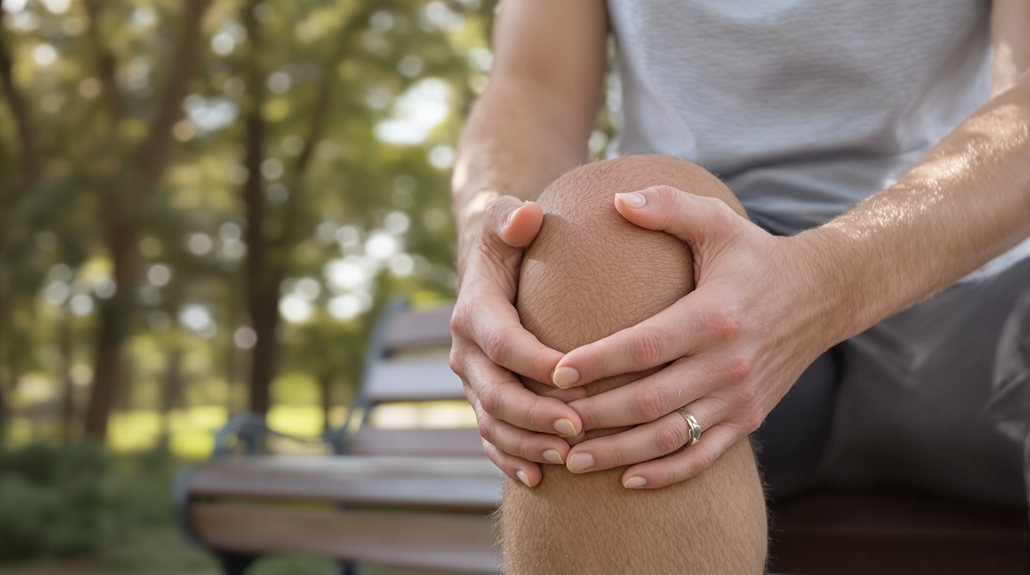
I remember standing in my driveway after my third knee surgery, thinking thirty feet was too far. Not thirty miles. Thirty feet.
The surgeon had done everything right. Physical therapy was done. I was cleared to move. Nobody told me what came next, or why every walk still felt like a negotiation.
If your knees hurt when you walk, you are probably in a version of that same place. You know movement is supposed to help. You are not sure where the line is between working through it and making it worse. And the advice you have gotten so far has been either too vague to act on or too aggressive to stick with.
That changes here.
Key Takeaway
When knee discomfort makes walking harder, the cause is rarely just one thing. Weak muscles, inflamed tissue, and compensated movement patterns tend to work against you together. A Cochrane review of 54 trials found that exercise-based programs improve function and reduce discomfort in people with knee osteoarthritis (Fransen et al., 2015). Addressing all three factors gives you the best chance of keeping moving.
Here is what the research says about each of those causes, what makes knee pain worse on a walk, and the smallest useful starting point for someone who has been near zero for months.
Ready to Find Out What Your Body Can Do?
It takes less than 3 minutes. No gym. No equipment. Just a simple test that shows you if your body can do more than it’s been telling you.
M3 is a behavioral wellness coaching program. It is not medical treatment and does not replace advice from your physician. Consult your doctor before beginning any new movement or nutrition program.
Why does walking make your knees hurt in the first place?
Pain has a way of making walking feel like a problem to solve by doing less of it. That instinct makes sense. But for most adults dealing with knee pain when walking, rest is not the fix. Movement is.
Your knees hurt when you walk for three specific reasons.
Joint inflammation irritates tissue that is already sensitive. When cartilage thins or synovial tissue becomes irritated, the repeated compression of walking aggravates what is already there. In most cases, this is not a sign that walking is causing further damage. It is a sign the joint needs a specific kind of movement, not no movement at all.
Weakened support muscles stop absorbing shock the way they should. The quadriceps, hamstrings, hip flexors, and calves are designed to absorb the force each step produces. After 55, muscle mass declines at roughly 1 to 2 percent per year without resistance work (Doherty, 2003). When those muscles cannot do their job, more of each step lands directly on the joint. The joint takes on load it was never designed to carry alone.
The unconscious way you shift your weight to protect a sore knee creates new strain over time. When a knee hurts, most adults change how they walk to avoid the pain. They shift weight, shorten stride, or rotate the foot outward. Over months, that protective pattern becomes habitual. What made sense in the short term starts creating new strain in the hip, ankle, and lower back.
Most people living with knee osteoarthritis and looking for a walking program are dealing with all three at once. Understanding each one changes what you do next.
Is knee pain when walking a sign that something is seriously wrong?

Is knee pain when walking a sign that something is seriously wrong?
For most people, no. But it depends on the type of pain you are feeling.
Some signals do warrant seeing a doctor right away. Sharp sudden pain after a fall or impact, visible swelling, or a feeling that your knee might give out: those need imaging and clinical assessment. Do not wait on those.
Ongoing chronic aching that has been around for weeks or months is a different pattern entirely. No single event caused it. It just showed up and stayed. That is common in adults managing knee osteoarthritis or age-related joint changes.
Research suggests this pattern typically responds better to graduated movement than to rest. Fransen et al. (2015) found that exercise led to meaningful improvements in function and reduced discomfort for people with knee osteoarthritis.
Nothing here substitutes for a conversation with your physician. If you are uncertain whether your knee pain is safe to work with, start there.
Ready to Find Out What Your Body Can Do?
It takes less than 3 minutes. No gym. No equipment. Just a simple test that shows you if your body can do more than it’s been telling you.
M3 is a behavioral wellness coaching program. It is not medical treatment and does not replace advice from your physician. Consult your doctor before beginning any new movement or nutrition program.
Does resting your knees actually help them heal?
If your knee has been aching for weeks or months with no clear injury behind it, resting it probably is not doing what you think it is.
For an acute injury, yes. Rest makes sense. But for chronic aching, the research says otherwise.
Your knee needs movement, not more rest. Synovial fluid, your joint’s built-in lubricant, only circulates when you move. When you stop moving, that fluid stagnates. Stiffness builds. And muscle mass keeps declining on its own, regardless of whether you are in pain or not.
That matters because the muscles around your knee are what take the load off the joint itself. When they weaken, your knee absorbs more of the work it was never meant to handle alone. You end up less able to do the things you want to do, not because the joint is damaged beyond hope, but because the support system around it has quietly faded.
Fransen et al. (2015) analyzed 54 randomized controlled trials and found that exercise consistently outperformed rest for long-term joint function in people with knee osteoarthritis. The people who kept moving, within their capacity, were the ones who stayed more capable over time.
What does starting a walking routine look like when you are near zero?
Two minutes is a real starting point. Not a warm-up. A session.
In the first weeks, the goal is not distance or pace. It is showing your knee that the movement is safe. That is how you build the daily pattern that actually sticks, especially when knee discomfort has been walking you back from activity.
| Week | Duration | Focus |
| 1 | 2 minutes | Joint safety signal |
| 2 | 4 minutes | Pattern building |
| 3 | 6 minutes | Light load tolerance |
Check in two to four hours after walking. That is your real data. Discomfort that ramps up post-session? Shorten the walk. Do not stop.
Does what you eat affect how your knees feel on a walk?

Yes, and more directly than most people expect.
Chronic joint discomfort has an inflammatory component. Foods like processed sugar, refined seed oils, and ultra-processed products raise your baseline inflammation. Your knees start every walk already more sensitized than they need to be.
Anti-inflammatory foods that joint health research points to include fatty fish, leafy greens, olive oil, and berries. These choices may help lower your baseline inflammation over time. They will not reverse structural changes in the joint. But less baseline inflammation often means your knees respond better during the same walk you did yesterday.
This is one piece of a larger picture, not the whole answer. Food choices work alongside movement, load management, and sleep. But it is something you can act on today.
How do you know if graduated movement is right for your situation?
Graduated movement is not the right answer for every knee situation. But it is right for more people than you might think.
Ask yourself three questions.
Is your knee pain chronic and ongoing rather than sudden and acute? If joint discomfort has been making walking difficult for months, not days, graduated movement is likely the right therapy.
Have you gotten medical clearance, or is there no reason to think your pain is an emergency? If yes, you do not have to wait to start.
Are you willing to start smaller than feels necessary? That is the piece most people skip when they are wondering why walking has become something they avoid, and nothing seems to help.
If you answered yes to all three, you are ready.
Ready to Find Out What Your Body Can Do?
It takes less than 3 minutes. No gym. No equipment. Just a simple test that shows you if your body can do more than it’s been telling you.
M3 is a behavioral wellness coaching program. It is not medical treatment and does not replace advice from your physician. Consult your doctor before beginning any new movement or nutrition program.
Wrap-up: Why do your knees hurt when you walk?
Knee pain during walking after 55 is rarely one thing. It is usually inflammation, weakened muscles, and a movement pattern your body developed to protect itself, all working together.
The part most adults get wrong is the response. Stopping movement feels like the safe choice. For acute injury, it is. For the chronic aching that shows up on a regular walk, the research points the other way. Joints need movement to stay lubricated. Muscles need load to stay capable. The habit of moving, even in very small doses, is what changes the pattern over time.
What you eat plays a role. How you sleep plays a role. What you tell yourself about your knees plays a role, too. None of those factors works as well in isolation as all three do together.
You do not need to walk far to start. Two minutes is a real session. The goal at the beginning is not fitness. It is proof, proof that your body responds to movement, that the pattern can shift, that you are not stuck where you are right now.
Frequently Asked Questions
Can knee pain when walking get worse before it gets better?
Yes, your knees can feel worse before they improve. That is normal as your body adjusts to movement it has been avoiding. The key signal to watch is how you feel two to four hours after a session, not during. Discomfort that ramps up hours later means shortening the session. Discomfort that fades is a sign you are working at the right level.
Should you walk on both bad knees or favor one side?
Do not favor one side. When you shift your weight onto your stronger knee to protect the other, you overload healthy tissue and create a second problem alongside the first. Walk as evenly as you can manage. If gait compensation has become habitual, a session or two with a physical therapist can help you reset the pattern.
What type of footwear makes the biggest difference for knee pain?
Cushioned, supportive sneakers with a firm midsole distribute load more evenly and reduce the impact your knees absorb with each step. Hard, flat shoes and worn-out soles are the two most common footwear issues in adults managing knee pain. Replace walking shoes every 300 to 500 miles, sooner if the midsole compresses visibly.
How long before graduated walking produces noticeable improvement?
Most people notice a meaningful reduction in discomfort within two to four weeks of consistent graduated walking. You will not feel it immediately, but small daily sessions build joint tolerance faster than you might expect. Fransen et al. (2015) found that walking-based exercise improved function in adults with knee osteoarthritis over 8 to 12 weeks of consistent effort.
Is swimming or cycling a better alternative when walking feels impossible?
Both work well. Cycling is the stronger choice for building quad strength without joint stress. Swimming reduces load on the joint entirely and is a solid option if walking is temporarily too painful to start. Both can serve as a bridge until graduated walking becomes manageable, and neither replaces walking as the long-term goal.
How is a walking program for knee pain different from regular exercise advice?
Standard exercise advice assumes a baseline level of movement capacity that many adults over 55 no longer have. A program designed for knee pain starts where you actually are, not where you think you should be. Two-minute sessions, post-session feedback tracking, and gradual progression are not modifications of a normal program. They are the program.
References
Doherty, T. J. (2003). Invited review: Aging and sarcopenia. Journal of Applied Physiology, 95(4), 1717-1727.
Fransen, M., McConnell, S., Harmer, A. R., Van der Esch, M., Simic, M., & Bennell, K. L. (2015). Exercise for osteoarthritis of the knee: A Cochrane systematic review. British Journal of Sports Medicine, 49(24), 1554-1557.