
If you have ever dragged yourself out of bed and spent the first ten minutes of your morning wondering if your knees were going to cooperate, you already understand morning knee stiffness causes and relief better than most doctors explain it. That slow, grinding warmup is not random. It has a reason. And once you know the reason, the fix makes complete sense.
If you recognize that feeling, you already know what morning knee stiffness causes and what relief looks like in practice. You learn your pattern. You take it slow. You wait for your body to catch up with the day.
But here is what most people do not know about why it happens.
KEY TAKEAWAY
Morning knee stiffness is caused by synovial fluid, your knee joint’s natural lubricant, thickening during sleep from hours of inactivity. Movement redistributes that fluid and reduces stiffness faster than rest. In adults with knee osteoarthritis, morning stiffness that resolves in less than 30 minutes with activity is a recognized clinical pattern, not a sign that something is getting worse (Duong et al., 2023).
Here is what is actually happening inside the joint, how long morning stiffness should last, and the one thing that helps most.
Ready to Find Out What Your Body Can Do?
It takes less than 3 minutes. No gym. No equipment. Just a simple test that shows you if your body can do more than it’s been telling you.
M3 is a behavioral wellness coaching program. It is not medical treatment and does not replace advice from your physician. Consult your doctor before beginning any new movement or nutrition program.
Table of Contents
Why do knees get so stiff overnight?
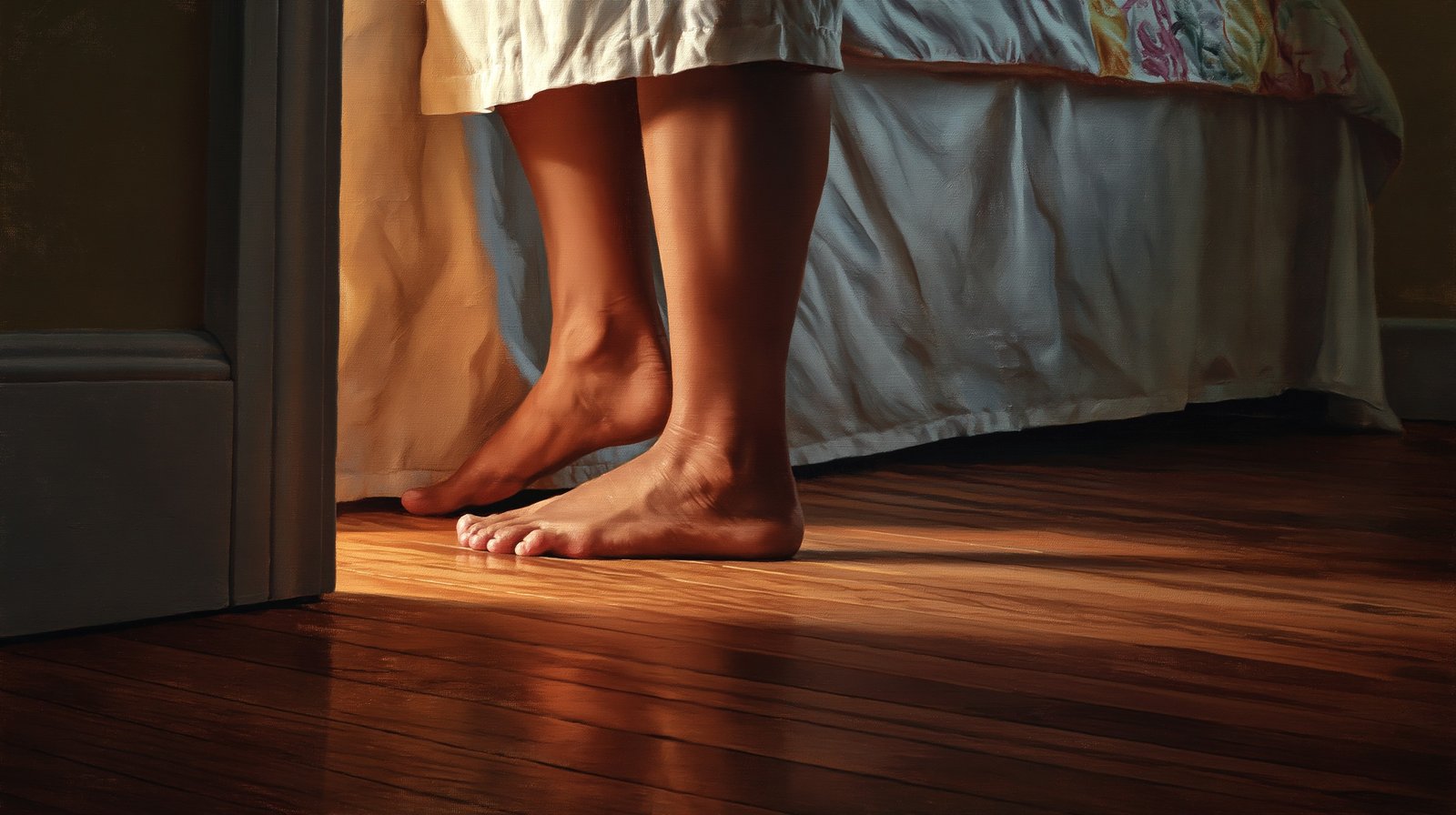
Your knee joint sits still for six to eight hours while you sleep, with very little movement to keep things circulating. The synovial fluid inside the joint, which normally acts as a lubricant between surfaces, thickens when it is not being moved through. Think of it like a jar of honey left in a cold kitchen overnight. It is still there. It just does not flow the way it did the day before.
That thickening is what creates the morning knee stiffness causes and relief pattern so many adults over 55 know well. The joint needs movement to warm that fluid back up and redistribute it across the cartilage surfaces. Without that movement, the first steps of the day feel stiff, slow, and sometimes a little unpredictable.
The good news is that the fix is built right into the problem. Movement is both the cause of relief and the trigger for it.
What is actually happening inside the joint?
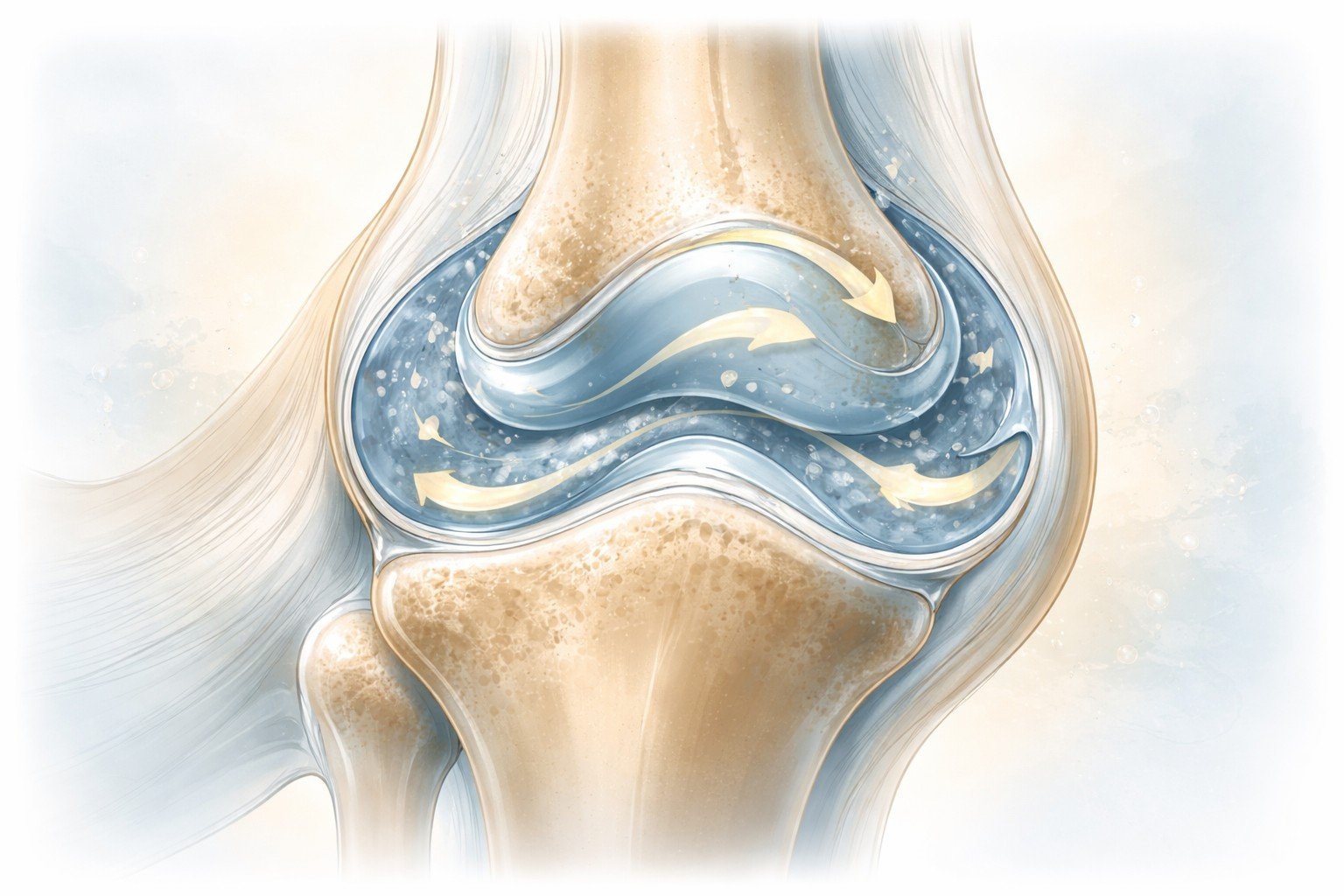
To understand morning knee stiffness causes and relief, start with cartilage. It has no blood supply of its own. It cannot receive nutrients directly the way muscle or bone does. Instead, it relies entirely on movement to absorb what it needs from the synovial fluid surrounding it. Every step you take compresses the cartilage slightly, squeezes fluid through it, then lets fresh fluid flow back in. That is how the joint feeds itself.
When you stop moving for hours, that exchange stops too. The fluid thickens. The cartilage sits without fresh lubrication. And the joint structures that normally glide smoothly have to work harder to get going again.
This is why rest does not solve morning knee stiffness. It is also why those first two minutes of movement feel so different from the two minutes after that. The joint is not broken. It is warming up.
How long should morning knee stiffness last?

In adults with knee osteoarthritis, morning stiffness that resolves within 30 minutes of movement is a recognized clinical pattern. A JAMA review identified morning stiffness lasting less than 30 minutes as a key diagnostic marker for knee OA, with 95% sensitivity (Duong et al., 2023). Stiffness that eases once you start moving is consistent with what clinicians expect. It is part of the condition, not a sign of deterioration.
What warrants attention is stiffness that persists well beyond 30 minutes most mornings, or stiffness accompanied by swelling, heat, or redness. Those patterns suggest something beyond the typical morning knee stiffness causes and relief cycle and deserve a conversation with your physician.
For most adults over 55, stiffness that loosens within the first 20 to 30 minutes is the body doing exactly what it is supposed to do once movement begins.
What is the one thing that actually helps?

Movement. Specifically, walking.
Not a long walk. Not a workout. Just enough movement to start redistributing the synovial fluid, engage the muscles around the knee, and let the joint warm up the way it is designed to.
Research on exercise and knee osteoarthritis consistently shows that low-impact movement reduces both pain and stiffness, with walking among the most supported approaches for adults in this age group (Fransen et al., 2015). The benefit is not just long-term. It starts within the first few minutes of the first session.
For morning knee stiffness causes and relief, the timing matters as much as the movement itself. Walking within the first few minutes of waking, before you sit back down with coffee or check your phone, gives the joint its best chance to loosen up before the day asks anything harder of it.
Two minutes is enough to start. The joint does not need much. It just needs to move.
What does a 3-minute morning movement routine look like?
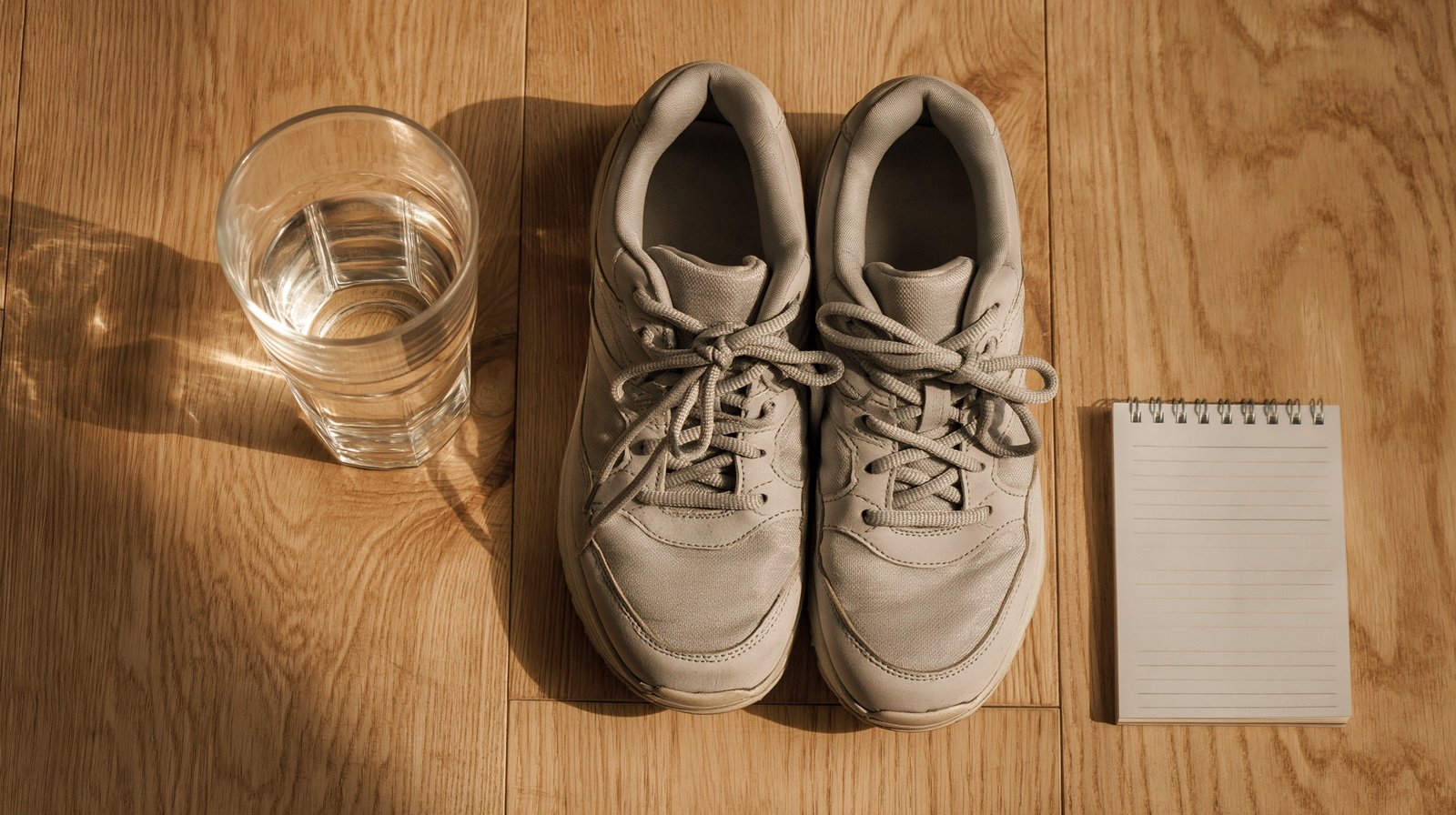
A 3-minute morning movement routine for adults over 55 with stiff knees. Three steps. No equipment. Do this every morning before anything else.
Drink a glass of water
Your joints need hydration to produce healthy synovial fluid. A glass of water before you move is a small signal that the day is starting.
Walk for 2 minutes
Easy pace. Around the house, down the hallway. You are not training. You are giving the joint what it needs to redistribute fluid and warm up the cartilage surfaces.
Stop and close your eyes for 30 seconds
Stand still. Breathe. Notice how your knees feel now compared to when you first got up. That shift is the joint responding to movement the way it was designed to.
For morning knee stiffness relief, consistency matters more than duration. Three minutes every morning beats thirty minutes three times a week.
Wrap-up: Why are my knees so stiff in the morning?
Because they have been still for hours, and they need you to move.
Morning knee stiffness causes and relief are two sides of the same mechanism. The joint thickens when it rests and loosens when it moves. That is not a problem to solve. It is a pattern to work with.
What changes outcomes is not finding the perfect stretch or the right supplement. It is showing up for two minutes every morning before the day gets in the way. Consistently. Before coffee. Before your phone. Before anything else asks something of your knees.
Morning stiffness is one piece of the larger picture of knee pain relief for adults over 55. Your body already knows how to do this. It just needs the chance.
Nothing in this post substitutes for a conversation with your physician. If you are uncertain whether your knee pain is safe to work with, start there.
Ready to Find Out What Your Body Can Do?
It takes less than 3 minutes. No gym. No equipment. Just a simple test that shows you if your body can do more than it’s been telling you.
M3 is a behavioral wellness coaching program. It is not medical treatment and does not replace advice from your physician. Consult your doctor before beginning any new movement or nutrition program.
Frequently Asked Questions
Is morning knee stiffness a sign of arthritis?
It can be, but it is not automatically a cause for concern. Morning knee stiffness causes and relief follow a predictable pattern in knee osteoarthritis: the joint stiffens with inactivity and loosens with movement. Stiffness that resolves within 30 minutes is consistent with OA. Stiffness lasting longer, or accompanied by swelling or heat, warrants a physician’s evaluation.
How long should morning knee stiffness last?
For adults with knee osteoarthritis, morning stiffness that eases within 20 to 30 minutes of moving around is a recognized clinical pattern (Duong et al., 2023). Morning knee stiffness lasting beyond 30 minutes is a different pattern than typical morning knee stiffness causes and relief.
What stretches help stiff knees in the morning?
The most effective thing for morning knee stiffness relief is not a stretch. It is walking. Even two minutes of easy movement redistributes synovial fluid and reduces stiffness faster than static stretching. If you want to add gentle range-of-motion work, slow ankle circles and knee bends while still in bed before you stand up are a reasonable addition.
Does morning stiffness get worse with age?
It can become more noticeable as cartilage thins and synovial fluid production changes with age. But morning knee stiffness causes and relief remain the same regardless of age — the joint responds to movement. Adults who walk consistently in the morning report less stiffness over time, not more (Fransen et al., 2015). The habit matters more than the age.
FAQ 5: Can walking really reduce morning knee stiffness?
Yes, and the mechanism is direct. Walking redistributes synovial fluid, compresses and nourishes cartilage, and engages the muscles that support the joint. Research on exercise and knee osteoarthritis consistently shows that low-impact movement reduces both stiffness and pain over time (Fransen et al., 2015). Two minutes first thing in the morning is enough to start that process.
Is it normal for knees to be stiff every morning?
For adults over 55 with knee osteoarthritis, yes. Morning stiffness that resolves within 30 minutes of movement is a recognized clinical pattern, not a sign of something getting worse (Duong et al., 2023). If your stiffness resolves once you start moving, your joint is responding the way it is supposed to. Stiffness that persists beyond 30 minutes most mornings is worth discussing with your physician.
References
Duong, V., Oo, W. M., Ding, C., Culvenor, A. G., & Hunter, D. J. (2023). Evaluation and treatment of knee pain: A review. JAMA, 330(16), 1568–1580. https://doi.org/10.1001/jama.2023.19675
Fransen, M., McConnell, S., Harmer, A. R., Van der Esch, M., Simic, M., & Bennell, K. L. (2015). Exercise for osteoarthritis of the knee: A Cochrane systematic review. British Journal of Sports Medicine, 49(24), 1554–1557. https://doi.org/10.1136/bjsports-2015-095424
Leave a Reply