
A client told me last month she had bought three pairs of walking shoes in six months. Each time her knees felt better for a week, then worse again. The shoe was not the answer, and the research agrees.
She was sure the fix was on a shelf somewhere. The right cushioning. The right brand. For her, walking shoes and knee pain were a shopping problem.
I hear this every week. Adults over 55 trying to figure out walking shoes and knee pain almost always start with the shoe. It makes sense. The shoe is the part you can swap out today. Your body is not.
What I see in clients’ lines up with what the studies show. Shoes matter less than most adults think.
Key Takeaways
Walking shoes affect how your knees feel during walking, but much less than most adults believe. A 2025 study found that walkers perceived clear differences between supportive and flexible footwear, while their actual movement showed no significant change (Katugam-Dechene et al., 2025). The honest truth on walking shoes and knee pain is that what you feel in a shoe and what your body does in it are often two different things.
The rest of the post lays out the research, what walking shoes can and cannot do for knee pain, and a simple way to tell if your shoes or your body is driving the discomfort. discomfort.
Ready to Find Out What Your Body Can Do?
It takes less than 3 minutes. No gym. No equipment. Just a simple test that shows you if your body can do more than it’s been telling you.
M3 is a behavioral wellness coaching program. It is not medical treatment and does not replace advice from your physician. Consult your doctor before beginning any new movement or nutrition program.
Table of Contents
Why do most adults blame their shoes first?

Because the shoe is the variable you can change today.
You can swap out a shoe in an afternoon. You can read reviews and feel like you are doing something about the knee pain. The body underneath the shoe is harder to think about, and much harder to change.
Marketing knows this. Every walking shoe ad tells you the right pair will change how you feel. And a new shoe does feel different for the first few walks.
Here is where it gets interesting. In a 2025 study, adults completed walking tasks in two very different shoes: a supportive hiking boot and a flexible sneaker. Walkers reported clear differences between the two. Their actual movement data showed almost none (Katugam-Dechene et al., 2025).
The shoe feels different. The body does what it was going to do anyway. This is the core of the research on walking shoes and knee pain. What you feel is not what your body does.
What do walking shoes actually do for knee pain?
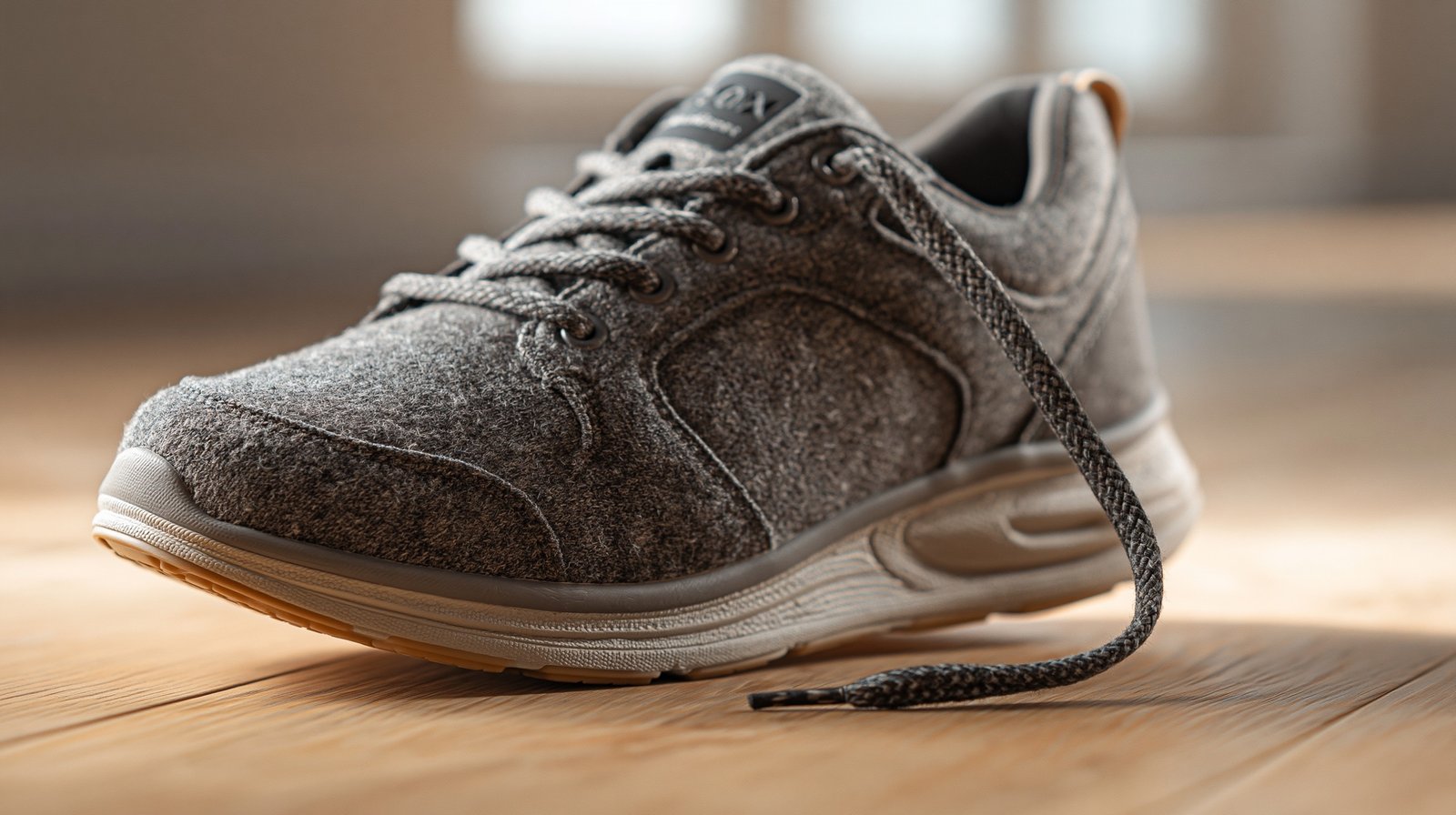
Less than most adults hope. More than nothing. That is the summary on walking shoes and knee pain.
Shoes change how force travels through your knee. They shift where the load lands and how your leg muscles respond. The right shoe nudges these things in a better direction. The effect is real, but small.
One study shows the ceiling plainly. Researchers designed a variable-stiffness shoe for one purpose: to reduce knee load in adults with medial compartment knee osteoarthritis. Engineers who understood the biomechanics built it from the ground up. The result was a reduction in the knee adduction moment of about 7 percent (Jenkyn et al., 2011).
A follow-up tracked the same shoes over six months in patients with knee pain. Pain scores and function improved, but the gains were modest, and the control group also saw some improvement (Erhart et al., 2010).
That is the honest answer on walking shoes and knee pain. Shoes help a little. They do not fix what is happening underneath.
Can the wrong walking shoes make knee pain worse?
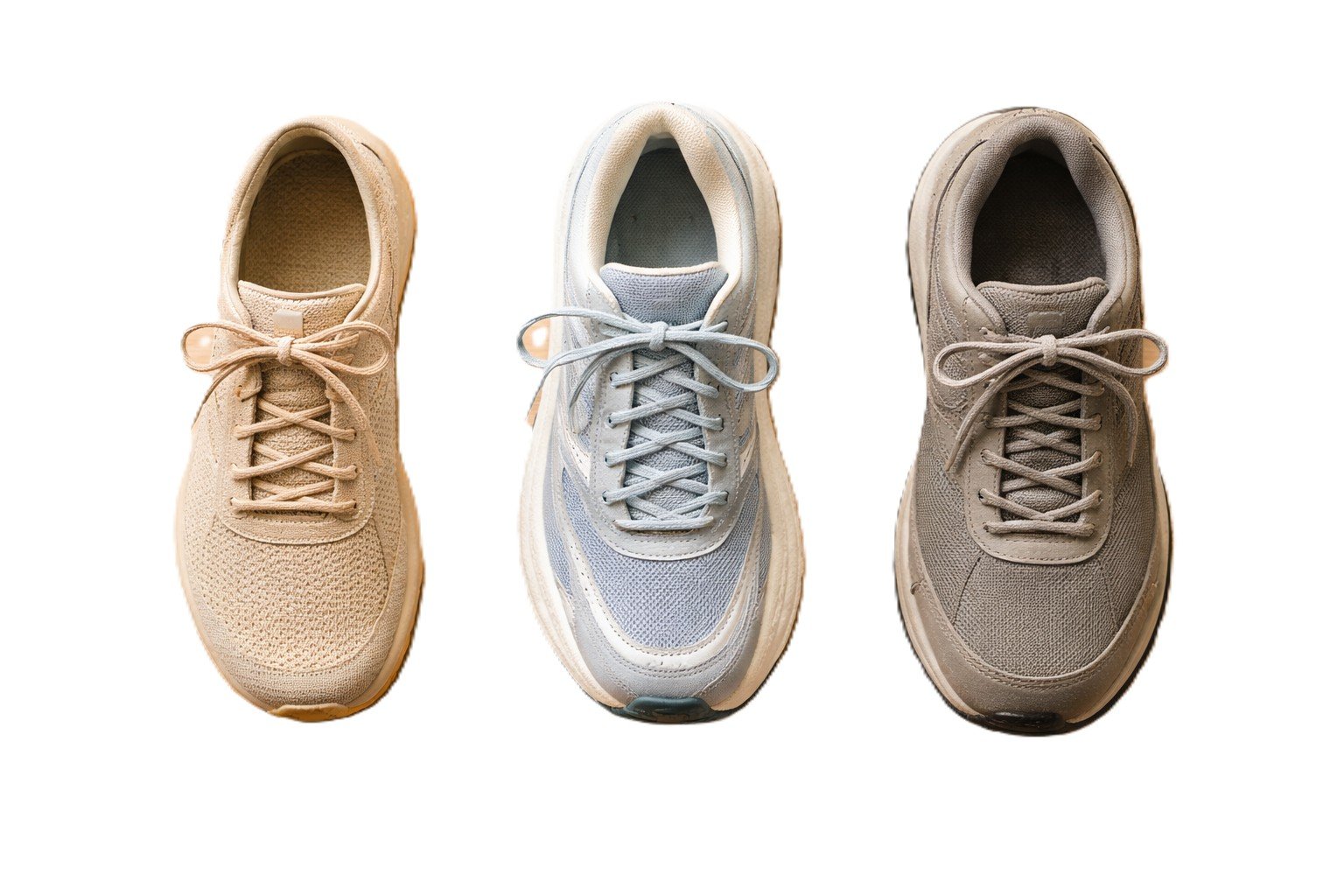
Yes. This is the honest counterweight to walking shoes and knee pain.
A 2021 study measured joint loads directly during walking using instrumented hip prostheses. Shoes with very stiff soles or elaborate cushioning increased hip joint loads compared to barefoot walking (Palmowski et al., 2021). Expensive and supportive does not automatically mean better for painful joints.
Researchers tested shoe features for balance in adults. Their recommendation after comparing soft soles, elevated heels, raised collars, and tread patterns was simple: a standard laced shoe with a low collar and a standard sole hardness (Menant et al., 2008). The fancy features did not help. Several made the balance worse.
Shoe wear matters too. Worn-out shoes change how your leg muscles stabilize your knee during walking (Jafarnezhadgero et al., 2020). If your knees hurt in an older pair, the answer may not be a fancier new pair. It may be any reasonable shoe that fits and is not broken down.
When clients ask about walking shoes and knee pain, this is where the conversation lands. Less is often more.
When should you actually replace your walking shoes?
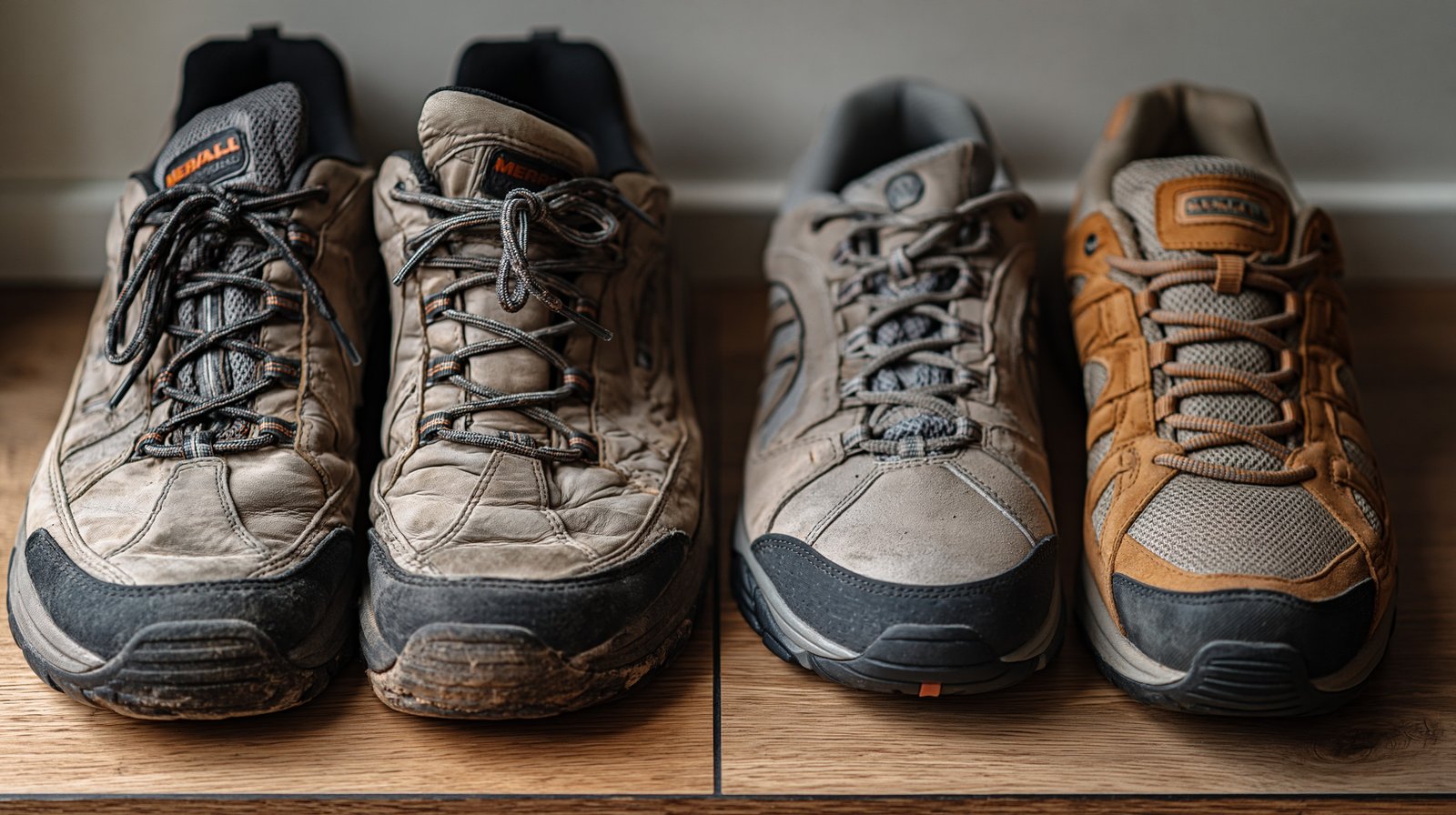
Between 300 and 500 miles, or about every six months, for daily walkers. A worn shoe is often the real driver of walking shoes and knee pain troubles.
The research gives a reason beyond the odometer. Studies tracking shoe use over six months show measurable changes in shoe stiffness and in the muscle co-contraction patterns your body uses to stabilize your knee and ankle during walking (Jafarnezhadgero et al., 2021). Your shoes are not the same at month six as they were at month one.
Three quick checks if you are wondering whether your shoes are done. Look at the outsole for smooth, worn patches where the tread used to be. Press the midsole with your thumb. If it stays compressed, the cushioning is gone.
Then check the flex point at the ball of the foot. A shoe that folds easily in the middle instead is past its life. That folding test alone catches a lot of worn shoes, and it can be one real reason adults over 55 struggle with walking shoes and knee pain in an older pair.
How do you know if your shoes are the problem or your body is?

You test it.
If your shoes are driving the discomfort, changing shoes or changing how you walk should change how your knees feel. If your shoes are not the main factor, your knees will respond to how you walk, not to what you wear.
That is what the Walk Test is for. It is a short three-day check that uses a simple walking pattern most adults over 55 can do in their own neighborhood. The test is not about your shoes. It is about what your body can do when you give it a specific kind of walk.
Three days is long enough to see a pattern. Short enough that you will not give up on it.
If your comfort changes across the three days, you have an answer. You have also learned something about walking shoes and knee pain that no shoe review can tell you. The answer to walking shoes and knee pain is about your body, not about your shoes. That is where any real solution starts.
Wrap-up: Walking shoes and knee pain after 55
The short version is this. Shoes matter, but less than most adults think. Even shoes engineered specifically to reduce knee load change joint forces by modest amounts. Too much cushioning or stiffness can work against you.
A worn-out shoe changes how your body moves, which is a better reason to replace shoes than any brand recommendation. If you have been asking which walking shoe will solve your knee pain, the better question is what your body is doing when you walk. For the structural side, the post on why your knees hurt when you walk covers what is happening underneath.
Walking shoes and knee pain are one piece of a larger picture. For the full approach to knee pain relief for adults over 55, the complete guide is the place to start.
Ready to Find Out What Your Body Can Do?
It takes less than 3 minutes. No gym. No equipment. Just a simple test that shows you if your body can do more than it’s been telling you.
M3 is a behavioral wellness coaching program. It is not medical treatment and does not replace advice from your physician. Consult your doctor before beginning any new movement or nutrition program.
Frequently Asked Questions
Are cushioned shoes or supportive shoes better for knee pain after 55?
The research is mixed, but newer evidence leans toward supportive over cushioned. A 2019 Australian trial of 164 adults over 50 with knee osteoarthritis found that 58 percent of participants wearing sturdy supportive shoes reported meaningful pain reduction, compared to 40 percent wearing flat flexible shoes (Paterson et al., 2019). For adults facing walking shoe and knee pain choices, support tends to outperform cushion alone.
Are running shoes better than walking shoes for knee pain after 55?
Not for most adults. Running shoes are built for repeated high-impact landings, which means stiffer heels and more aggressive forefoot geometry than your walking stride needs. A well-fitted walking shoe or a neutral athletic shoe usually feels better during long walks. Running shoes can work if they fit your foot and feel comfortable for your pace.
Do rocker-bottom shoes help with knee pain when you walk?
Sometimes. Rocker-bottom shoes shift how your foot rolls through each step, which can reduce load on the knee for some walkers. Research on specialized rocker designs found modest benefits similar to standard walking shoes. If a rocker bottom feels more comfortable during a full walk, it may be worth trying. If not, a standard walking shoe works fine.
Why do your knees hurt more after walking on hard surfaces?
Hard surfaces return more force to your joints with each step. Concrete and asphalt give you almost no give, so your shoes and your body absorb everything. Softer surfaces like grass, dirt paths, and rubberized tracks cushion the impact. If your usual walking route is all sidewalks, adding even one softer-surface walk per week can reduce cumulative strain.
How do you break in new walking shoes if your knees already hurt?
Start with short walks of 10 to 15 minutes for the first three or four days. New shoes change how force travels through your legs, and your muscles need time to adapt. If your knees feel worse after a new pair for more than two weeks of regular use, the fit may be wrong for your foot. A specialty walking store can help you check.
How do you break in new walking shoes if your knees already hurt?
Start with short walks of 10 to 15 minutes for the first three or four days. New shoes change how force travels through your legs, and your muscles need time to adapt. If your knees feel worse after two weeks of regular use, the fit may be wrong. A specialty walking store can help you check.
References
Erhart, J. C., Mündermann, A., Elspas, B., Giori, N. J., & Andriacchi, T. P. (2010). Changes in knee adduction moment, pain, and functionality with a variable-stiffness walking shoe after 6 months. Journal of Orthopaedic Research, 28(7), 873–879. https://doi.org/10.1002/jor.21077
Jafarnezhadgero, A. A., Anvari, M., & Granacher, U. (2020). Long-term effects of shoe mileage on ground reaction forces and lower limb muscle activities during walking in individuals with genu varus. Clinical Biomechanics, 73, 55–62. https://doi.org/10.1016/j.clinbiomech.2020.01.006
Jafarnezhadgero, A. A., Piran Hamlabadi, M., Anvari, M., & Zago, M. (2021). Long-term effects of shoe mileage on knee and ankle joints muscle co-contraction during walking in females with genu varus. Gait & Posture, 89, 74–79. https://doi.org/10.1016/j.gaitpost.2021.07.004
Jenkyn, T. R., Erhart, J. C., & Andriacchi, T. P. (2011). An analysis of the mechanisms for reducing the knee adduction moment during walking using a variable stiffness shoe in subjects with knee osteoarthritis. Journal of Biomechanics, 44(7), 1271–1276. https://doi.org/10.1016/j.jbiomech.2011.02.013
Katugam-Dechene, K., Cook, A., Nguyen, A., Smith, R., Shelton, A., & Franz, J. R. (2025). The effects of shoe structural features on agility and stability tasks during walking. PeerJ, 13. https://doi.org/10.7717/peerj.19930
Menant, J. C., Perry, S. D., Steele, J. R., Menz, H. B., Munro, B. J., & Lord, S. R. (2008). Effects of shoe characteristics on dynamic stability when walking on even and uneven surfaces in young and older people. Archives of Physical Medicine and Rehabilitation, 89(10), 1970–1976. https://doi.org/10.1016/j.apmr.2008.02.031
Palmowski, Y., Popović, S., Kosack, D., & Damm, P. (2021). Analysis of hip joint loading during walking with different shoe types using instrumented total hip prostheses. Scientific Reports, 11(1), 10073. https://doi.org/10.1038/s41598-021-89611-8
Leave a Reply