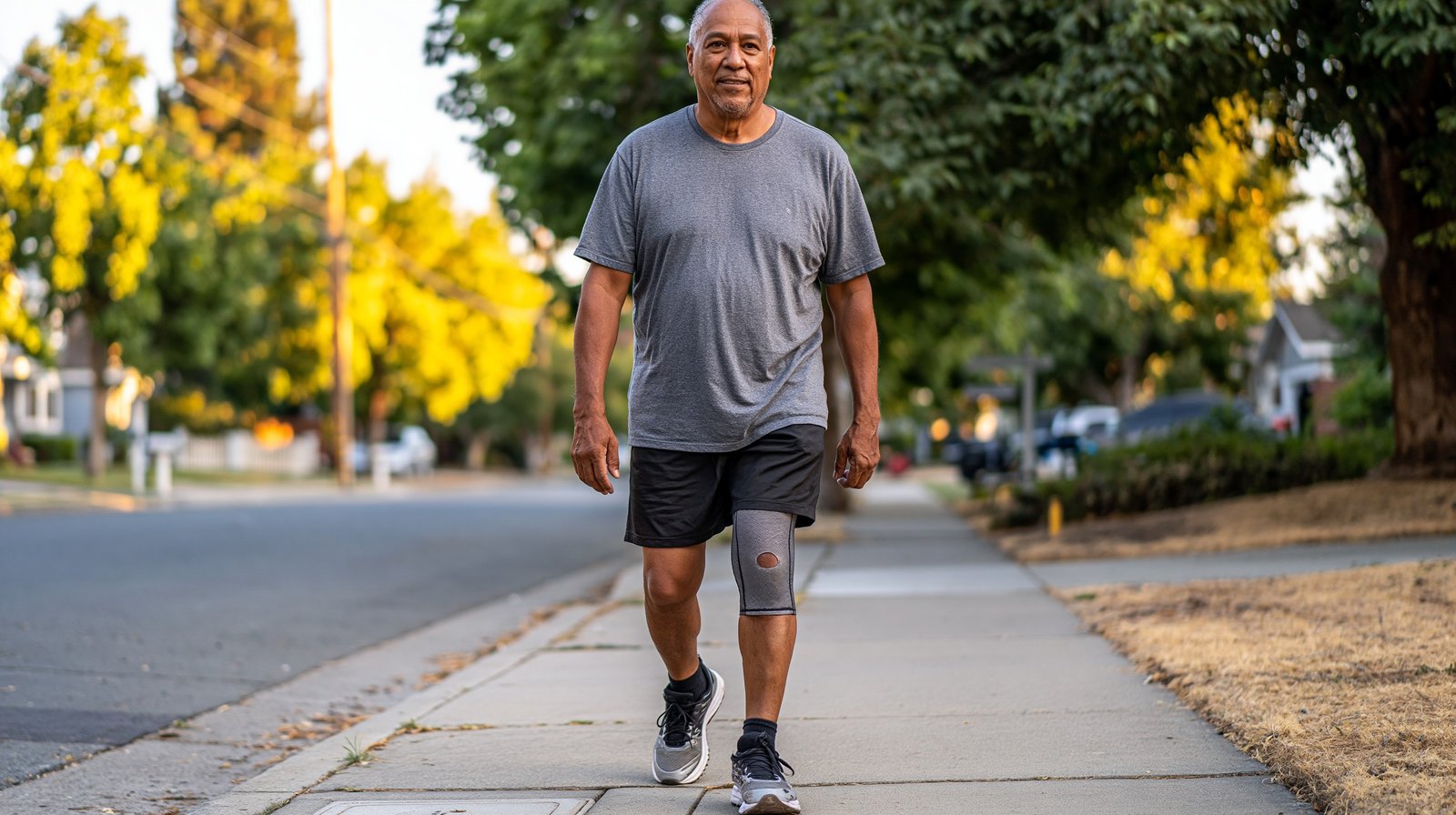
Most adults with bad knees make one of two mistakes. They push through the pain until something forces them to stop, or they quit moving altogether and wait for things to improve. Frank tried both. A friend who had dealt with her own knee pain finally talked him into making that first call. He showed up certain that knowing how to walk with bad knees was not his problem. Walking was.
For adults over 55 with knee osteoarthritis, the evidence says otherwise. Among 1,212 adults aged 50 and older with knee OA, those who walked for exercise had 40% lower odds of developing new frequent knee pain than those who did not (Lo et al., 2022). The issue is rarely the walking. It is how the walking gets done.
Key Takeaway
Among 1,212 adults aged 50 and older with knee OA, walkers had 40% lower odds of developing new frequent knee pain vs. non-walkers (Lo et al., 2022). Walking at least 6,000 steps daily was the strongest predictor of avoiding functional limitation over two years in knee OA adults (White et al., 2014). Walking helps. The approach determines how much.
This post covers whether walking is safe for bad knees, why most adults start wrong, and a 6-step approach to how to walk with bad knees that builds from 2 minutes toward 30.
Ready to Find Out What Your Body Can Do?
It takes less than 3 minutes. No gym. No equipment. Just a simple test that shows you if your body can do more than it’s been telling you.
M3 is a behavioral wellness coaching program. It is not medical treatment and does not replace advice from your physician. Consult your doctor before beginning any new movement or nutrition program.
Table of Contents
Is it safe to walk with bad knees?

For most adults with knee osteoarthritis, yes. And not just safe, but beneficial.
Among 1,212 adults aged 50 and older with knee OA, those who walked for exercise had 40% lower odds of developing new frequent knee pain compared to those who did not walk. Walkers also showed less structural damage inside the joint over four years (Lo et al., 2022). The evidence points in one direction: movement protects, inactivity compounds the problem.
The fear that walking will accelerate joint damage is one of the most common reasons adults with bad knees stop moving. A five-year study of adults with advanced structural knee OA found that daily walking did not increase the risk of knee replacement and may be protective in some cases (Master et al., 2021). Even in the most affected knees, walking did not make things worse.
Knowing how to walk with bad knees starts with understanding that the activity itself is not the enemy. The approach is what matters.
Why do most adults with bad knees walk too far too soon?

Because the standard advice does not fit them.
The CDC recommends 30 minutes of moderate activity a day for healthy adults. That is solid guidance for someone whose knees are not a limiting factor. For an adult with knee OA who has been mostly sedentary for months, 30 minutes on day one is not a starting point. It is an overload.
A joint that has been guarded and underused needs time to relearn that movement is safe. Starting at 30 minutes bypasses that process. The result is a walk that ends badly, a knee that protests for two days after, and a conclusion that feels obvious but is wrong: walking made it worse.
It did not. The dose made it worse.
Most adults asking how to walk with bad knees already know they should walk. What they need is a starting point that matches where their body actually is right now.
How do you walk with bad knees step by step?
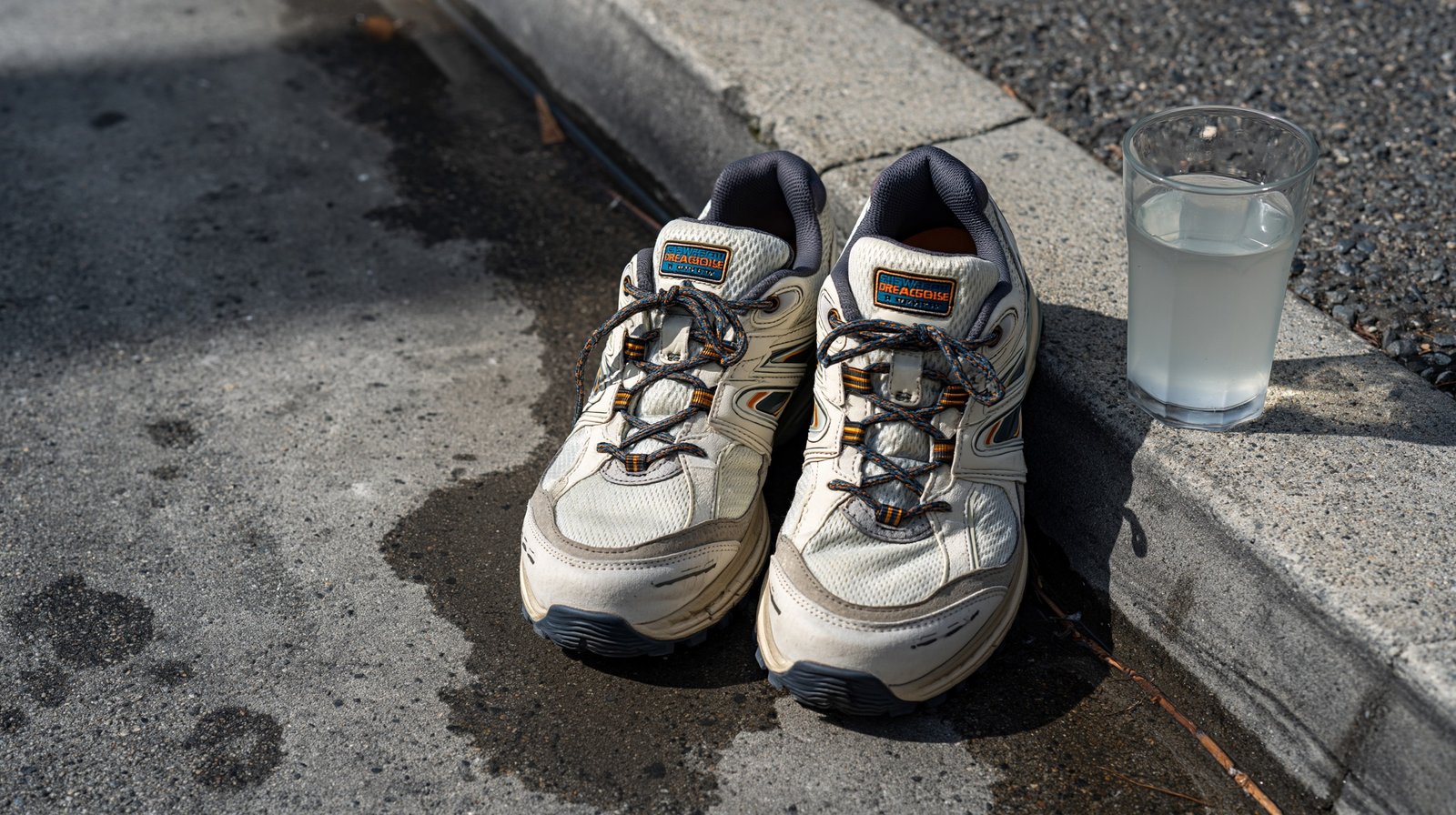
These six steps are how to walk with bad knees, whether you are starting from zero, starting over, or starting cautiously after a setback.
Step 1: Choose a flat surface and supportive shoes
Before distance or duration, surface and footwear matter. Asphalt, packed dirt trails, and indoor tracks absorb more impact than concrete sidewalks. Flat surfaces reduce the demand on a knee that is already managing more than it would like. Your walking shoes should have a low heel-to-toe drop, a firm heel cup, and a wide toe box. Hard, sloped, or uneven surfaces come later. Not on day one.
Step 2: Drink a glass of water before you start
This takes under sixty seconds, and it matters. Your knee joint relies on synovial fluid for lubrication and shock absorption. That fluid is mostly water. Walking when you are even mildly dehydrated means the joint is working with less of what it needs. Drinking a glass of water before your walk is also a behavioral cue. It signals to your body and your brain that the walk is beginning. Cues like this are how habits form.
Step 3: Start at 2 to 3 minutes at a comfortable pace
Two to three minutes. Not ten. Not the twenty minutes your doctor suggested last year. Two to three minutes at a pace where you could hold a conversation without effort. This is not a warm-up. This is the walk. For an adult with a knee that has been guarded for weeks or months, a 2-minute walk is real data. It tells you what your body can do right now without overloading a joint that has not been asked to do much lately.
Step 4: Check in with how you feel when you finish
When you return, ask one question: do you feel better, the same, or worse than when you started? Not how your knee scored on a pain scale. Just better, same, or worse. Better means your body responded well to movement. Worse, or significantly worse the following morning, means the next walk should be shorter or the surface should be softer. Three consecutive walks that finish better than they started is your green light to build. This three-day check is the same principle behind the 3-Minute Walk Test at enneadhealth.com.
Step 5: Add 1 to 2 minutes every 3 to 4 days
Once you have three consecutive walks that end better than they started, add 1 to 2 minutes to your next session. Not every walk. Every 3 to 4 days. Adults with knee OA who exercised aerobically at higher frequencies showed a graded pattern of improvement in both pain and function, with the greatest gains in those who exercised consistently 3 to 6 times per week (Komolsuradej et al., 2026). Consistency and gradual progression together are the mechanisms.
Step 6: Anchor your walk to something you already do
Pick one time of day and attach your walk to a habit you already have. After your morning coffee. Before dinner. The same time each day removes the daily decision. A walk that requires a fresh decision every morning gets skipped. A walk that follows the coffee does not. Consistency beats distance every time for adults building a walking practice with bad knees.
How far should you walk when your knees hurt?

The research gives a specific answer that most people never hear.
A study of 1,788 adults with or at risk of knee OA found that walking at least 6,000 steps per day best predicted avoiding functional limitation over two years. Each additional 1,000 steps was associated with a 16 to 18 percent reduction in the risk of developing difficulty walking, climbing stairs, or rising from a chair (White et al., 2014).
Six thousand steps is not a day-one target. It is a destination, the threshold where meaningful protection against functional decline begins.
Build there gradually. A 2-minute walk is roughly 200 steps. A 10-minute walk is roughly 1,000. You do not need to reach 6,000 in a single session. You need to reach it across the day.
One signal to watch as you build: waking with more morning stiffness than usual after a walk means you added too much too soon. Shorten the next session and rebuild from there.
Knowing how to walk with bad knees means knowing not just how to start but how to read what your body tells you as you go.
How do you keep walking consistently with bad knees?

By making the decision once instead of every day.
Adults with knee OA who exercised aerobically 3 to 6 times per week showed the greatest improvements in pain and function. Once a week produced modest results. The sweet spot is consistent, frequent movement with one or two rest days built in.
Consistency at that frequency does not come from motivation. It comes from structure. If the walk requires a fresh decision every morning, it will get skipped on the hard mornings. If it follows the coffee, it does not.
Pick one time of day and attach the walk to something that already happens. After your morning coffee works for most people. Before dinner works if mornings are unpredictable. The point is one consistent anchor, one consistent time, already built into the day.
For adults learning how to walk with bad knees, the biggest predictor of keeping going is not pain tolerance. It is whether they built something the walk could attach to.
Wrap-up: How to walk with bad knees
Walking is not what hurts your knees. Doing too much too soon is. Adults with knee OA who walk regularly have lower rates of new pain, less structural damage, and better function over time than those who stop moving.
The six steps here are a starting point, not a program. Surface, water, two minutes, a feel check, a gradual build, and a daily anchor. That sequence works because it matches where most adults with bad knees actually are.
The goal is not staying at two minutes. The goal is walking 30 minutes, and these six steps are how you start building toward it.
How to walk with bad knees is one piece of a larger picture. The complete guide to knee pain relief for adults over 55 covers the full approach.
Ready to Find Out What Your Body Can Do?
It takes less than 3 minutes. No gym. No equipment. Just a simple test that shows you if your body can do more than it’s been telling you.
M3 is a behavioral wellness coaching program. It is not medical treatment and does not replace advice from your physician. Consult your doctor before beginning any new movement or nutrition program.
References
Komolsuradej, N., Boonlertwanich, P., Klaylian, N., Hiranchunha, K., Malang, D., Intharak, P., Sangkaew, P., Bandrapiwat, S., & Srikrajang, S. (2026). Frequency of aerobic exercise and association with pain and function in older adults with knee osteoarthritis: A cross-sectional study. Life, 16(3), 405. https://doi.org/10.3390/life16030405
Lo, G. H., Vinod, S., Richard, M. J., Harkey, M. S., McAlindon, T. E., Kriska, A. M., Nevitt, M. C., & Driban, J. B. (2022). Association between walking for exercise and symptomatic and structural progression in individuals with knee osteoarthritis: Data from the Osteoarthritis Initiative cohort. Arthritis & Rheumatology, 74(10), 1660–1667. https://doi.org/10.1002/art.42241
Master, H., Thoma, L. M., Neogi, T., Dunlop, D. D., LaValley, M., Christiansen, M. B., Voinier, D., & White, D. K. (2021). Daily walking and the risk of knee replacement over five years among adults with advanced structural knee osteoarthritis in the United States. Archives of Physical Medicine and Rehabilitation, 102(10), 1888–1894. https://doi.org/10.1016/j.apmr.2021.05.014
White, D. K., Neogi, T., Nevitt, M. C., Peloquin, C. E., Zhu, Y., Boudreau, R. M., Newman, A. B., & Kwoh, C. K. (2014). Daily walking and the risk of incident functional limitation in knee OA: An observational study. Arthritis Care & Research, 66(9), 1328–1336. https://doi.org/10.1002/acr.22362
Leave a Reply